Skip to content
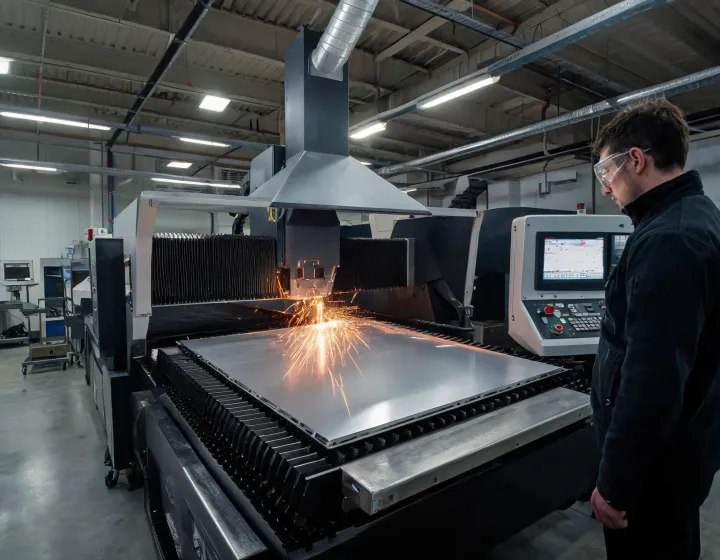
Operator watching a fiber laser cutting stainless sheet on a shuttle table with extraction hood

Replacement versus new installation

Existing process

Many plants replace a CO2 resonator or a worn turret punch because edge quality, small-hole piercing or nested sheet utilization no longer meets the current mix. A new fiber laser cutting machine still has to fit the same pit, crane coverage and pallet path; catalog laser power in kW does not by itself prove the old nest will finish faster on the new bed.

Ask each bidder to state which existing loader, extraction stack and crane envelope they will reuse, and which items they will quote as new site work.

Site interface register

Comparable quotes start with the same electrical, utility and control list. Leave a row blank only when the factory must survey the bay; do not let one bidder assume 480 V / 60 Hz while another assumes 380 V / 50 Hz.

Connections to confirm
InterfaceBuyer input
ElectricalVoltage, phase, frequency and connected load in kW for resonator, chiller and shuttle, plus any regenerative brake or high-inrush item.
UtilitiesNitrogen or oxygen assist-gas plan, consumption basis by grade and thickness, extraction airflow, cooling-water flow and compressed-air demand.
ControlsPLC interface to a loader or sorter, nesting license ownership and whether a FAT remote witness is included.

Documents that define a fiber laser cutting machine RFQ

  • Drawing or process description

    Send a representative nest, not a single pretty part. Include hole sizes, corner radii, long contours, grain direction and which faces must stay dross-free. Note stainless, mild steel and aluminum thicknesses that will fill the weekly schedule. A public manufacturer page may list working range in millimetres, machine weight in kilograms and laser power in kilowatts; treat those as units to request, not as this site’s promised models.

  • Operating conditions

    State shift pattern, duty cycle, who loads pallets, and whether parts must stay in the skeleton until a sorter picks them. Throughput claims without material, thickness and nest conditions are not comparable. If the line later needs a tube station, that is a separate chucking envelope and is not proven by a flat-sheet bed.

Missing information does not stop an inquiry, but factories will then quote assumptions. We will list those assumptions instead of inventing a thickness mix or a gas consumption average.

Questions buyers ask before requesting quotes

Which procurement scope is covered by a fiber laser cutting machine?
  • Drawing or process description

    Scope is the cutting cell itself: bed, resonator option, shuttle, guarding and the software the factory lists as standard. Loading, unloading, sorting, extraction design and tube chucks stay out of that cell unless named on the same quotation sheet.

  • Operating conditions

    The buyer remains responsible for floor loading, crane coverage, local electrical code and who signs FAT and SAT. The supplier confirms feasibility against the nest and utilities you provide; this intermediary does not certify a plant layout.

If you only have a part photograph, say so. We still collect quantity and destination so logistics can be quoted as a separate line.

Which material grades and thicknesses belong in the cut trial?

Name the grades that fill the schedule, not a catalog maximum. Ask the factory to cut that mix with the proposed assist gas, nozzle and piercing method, then record sheet processing time and acceptable-part count. Edge dross, hole taper and part flatness should be written as pass/fail before anyone treats cycle time as a commercial number. Public fiber-laser literature often separates cutting functions from laser power; use that distinction when two offers show different kilowatt labels on similar nests.

Send a trial nest with your factory enquiry

Discuss Your Requirements